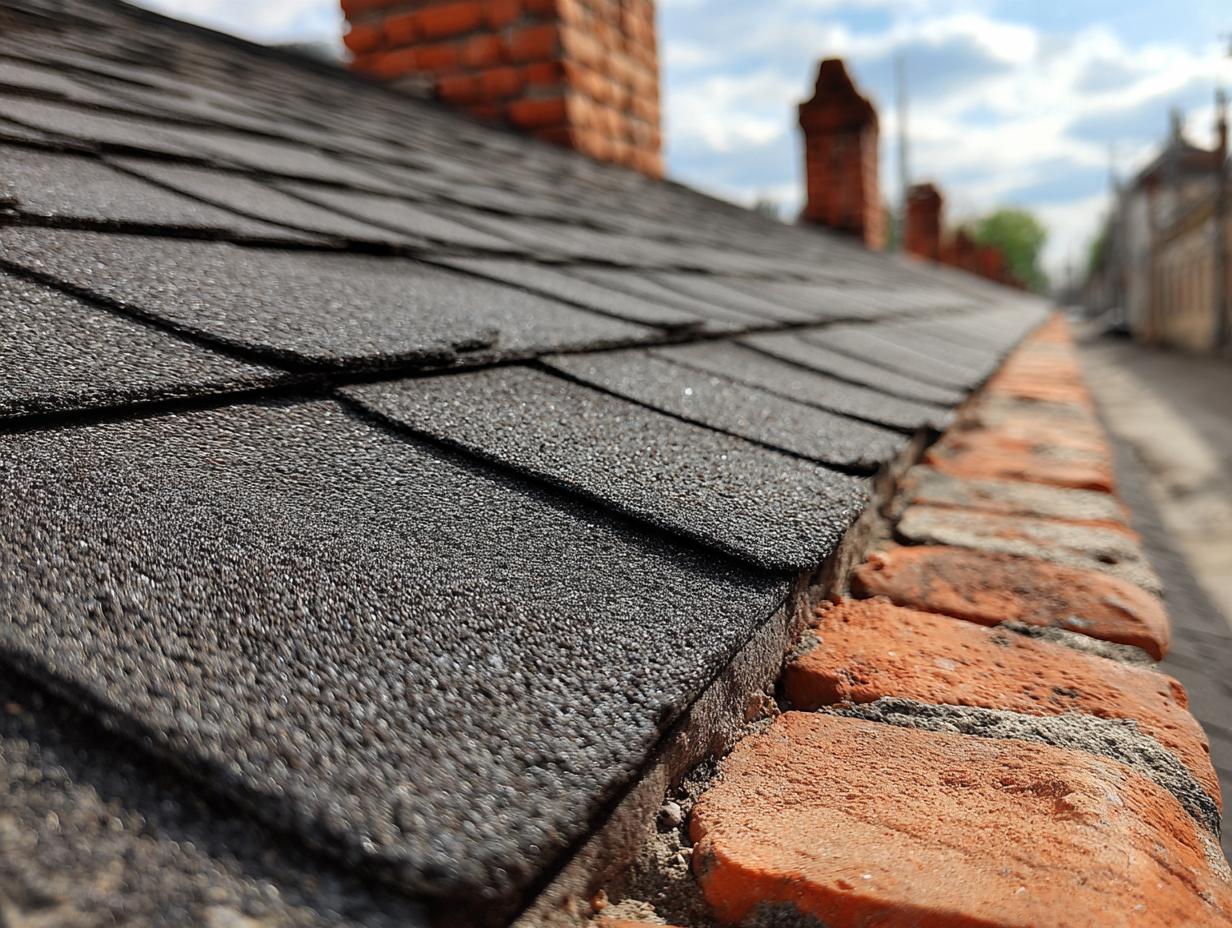
What Roof Repair Covers
Roof repair means fixing a specific failure on a roof that's otherwise sound: a few blown-off shingles, lifted flashing at a wall or chimney, a cracked rubber boot around a vent pipe, an open seam on a flat membrane, a split parapet cap. In Newark, where so many buildings have flat or low-slope roofs, a large share of repairs are seams, edges and drains rather than shingles. A good repair also answers one question for the owner: is this a one-off problem, or the first sign the roof is near the end?
The Repairs Roofers Do Most
| Problem | What's usually wrong | What the repair involves |
|---|---|---|
| Stain on the top-floor ceiling | Flashing, a vent boot or a seam above, often not directly over the stain | Tracing the leak path, then sealing or replacing the failed detail |
| Missing or lifted shingles | Wind broke the seal, or nails backed out | Replacing shingles and re-sealing the area around them |
| Leak at a chimney or wall | Step or counter-flashing has pulled away or rusted | New flashing, sometimes new counter-flashing cut into the mortar |
| Leak around a vent or pipe | The rubber boot has cracked in the sun | A new boot or collar |
| Flat roof seam or blister | Adhesive failed, or moisture is trapped under the membrane | Cutting out and patching, or re-seaming the area |
| Parapet cap or coping | Joints opened, or the cap is loose | Re-securing or replacing the cap and sealing the joints |
| Ponding near a drain | A clogged drain, or the deck has sagged | Clearing the drain; adding taper or a new drain if it keeps holding water |
The Stain Is Rarely Under the Leak
Water that gets through a roof travels before it shows. On a pitched roof it runs down the rafters or along the top of the ceiling. On a flat roof it can slide under the membrane and appear a room away. In older two- and three-family houses it sometimes follows a wall cavity down a floor. That's why roofers trace the path from above and below (the attic, a top-floor closet, the roof itself) before they start cutting or sealing. Patching where the stain is, instead of where the water enters, is the most common reason a "fixed" roof leaks again.
Stain on the top-floor ceiling?
Get the leak in front of a roofer: (973) 528-8938.
Call (973) 528-8938When a Repair Stops Making Sense
A repair is the right call when the failure is local and the roof around it still has life. It stops being the right call when:
- the roof has needed several repairs in different spots over a short time
- the shingles are curling, cracking or shedding granules everywhere, not just at one spot
- a flat membrane has widespread blisters, shrinkage or open seams
- the deck underneath is soft or rotted
- there are already two layers, so the next fix has to be a tear-off anyway
A roofer will usually tell you honestly which side of that line you're on. The full decision guide: repair or replace.
What a Roofer Looks At
- The deck: soft spots, sagging or rot under the roofing
- The layers: how many roofs are already on the building
- Flashing: at walls, chimneys, parapets, skylights and the edges
- Penetrations: vents, pipes, exhaust fans, satellite mounts and rooftop equipment
- Drainage: gutters, downspouts, scuppers and flat-roof drains
- The attic or top floor: stains, wet insulation and daylight where there shouldn't be any
If the roof is reached through a tenant's unit or a roof hatch, arrange access ahead of time. If you're a tenant, the building owner arranges the work, so let your landlord know.
Can One Section of a Roof Be Repaired?
Yes, and it's common. A section repair replaces shingles or membrane over a limited area: the side of a roof that took the wind, the area around a chimney, the low corner of a flat roof where water collects. On shingles, matching color exactly can be hard on an older roof, so expect the repair to show from the street. On a flat roof, a patch or section replacement is often invisible from the ground. Either way, the roofer should explain what's being replaced and why.
While You Wait for the Roofer
Stay off the roof, wet or dry, and leave ladders alone. Indoors, put a bucket under the drip, move furniture and electronics away, and keep clear of any ceiling that bulges or sags. If water is near a light fixture or outlet, turn off that circuit at the panel if you can do it safely. Take photos of the ceiling and any damage. They help the roofer, and they help if there's an insurance claim. More on storm-related leaks: leaks & storm damage.
Mansard Fronts and Flat Tops
A very Newark repair: the two- or three-family house with a flat roof on top and a steep shingled mansard on the front. Water gets in where the two meet, at the top edge of the mansard, where the flat roof's membrane has to lap over or tie in. It also gets in around dormer windows set into the mansard, and at the bottom where the mansard meets the cornice or a box gutter. Leaks show up near the front wall of the top floor. A roofer will usually look at the joint from above and the mansard from a ladder or the window before deciding what to repair.
After a Repair
Keep the roofer's description of what was fixed, with photos if they took them. Watch the ceiling below for a few rains. A small stain that doesn't grow is often old water drying out, while a stain that spreads means the leak wasn't the only one. If a repair fails, the roofer who did it should be the first call.
Roof Repair Around Newark
North
West
South
Downtown
Essex
- IrvingtonEssex County
- East OrangeEssex County
- OrangeEssex County
- BloomfieldEssex County
- BellevilleEssex County
- NutleyEssex County
Hudson
Union
Main page: roofing in Newark, NJ.