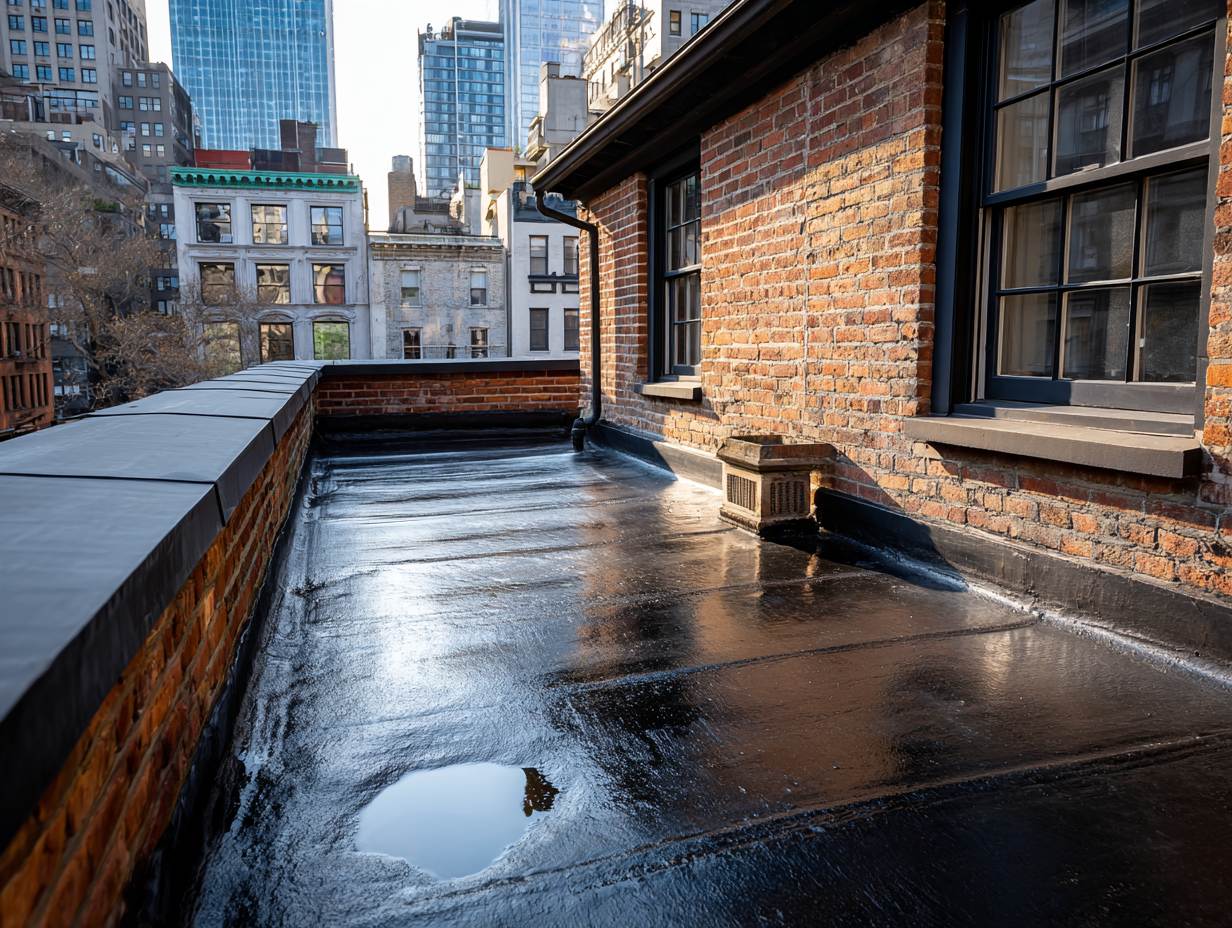
Why Newark Has So Many Flat Roofs
Newark grew up as a city of attached and closely spaced buildings: frame two- and three-family houses, brick rowhouses, small apartment buildings and corner stores with living space above. Many of them were built with flat or very low-slope roofs, often hidden behind a parapet wall or a shingled mansard on the front. Flat roofs aren't actually flat. They're built with a slight pitch toward drains, scuppers or gutters. When that drainage works and the membrane is sound, they last. When water sits, seams open, or flashing at the parapet fails, they leak, usually into the top-floor unit.
Flat Roof Materials at a Glance
| Material | What it is | Typical strengths | What to watch |
|---|---|---|---|
| EPDM (rubber) | A large sheet of synthetic rubber, usually black | Flexible, handles freeze and thaw, simple to patch | Seams and edges are the weak points; black absorbs heat |
| TPO | A white or light-colored single-ply membrane with heat-welded seams | Reflects sun, strong welded seams | Quality varies by product and installer |
| Modified bitumen | Asphalt-based rolls, torched or self-adhered, often with a granule surface | Tough, multi-layer, good with foot traffic | Torch-down needs care near wood; seams and flashings age |
| Built-up roof (tar and gravel) | Layers of felt and asphalt, often under gravel | Durable when maintained | Heavy; hard to find leaks; older systems common on old buildings |
| Coatings | Liquid-applied coatings over an existing roof | Can extend life of a sound roof | Not a fix for a wet or failing roof underneath |
A fuller comparison: flat roof materials compared.
Ponding Water and Drains
Water that sits on a flat roof for days after rain is called ponding. It speeds up wear on the membrane, finds every weak seam and adds weight to the deck. Common causes in Newark are clogged drains and scuppers, gutters packed with leaves, a deck that has sagged over the years, or a roof that was re-covered without correcting the slope. Fixes range from clearing the drain to adding tapered insulation that pitches water to an outlet. Spotting the signs early: signs a flat roof is failing.
Parapets, Party Walls and Edges
On attached buildings, the flat roof usually ends at a parapet: a short wall that rises above the roof line. The membrane has to turn up that wall and be capped and flashed properly, and the wall itself has a coping or cap on top. Water gets in where the cap joints open, where mortar has worn, or where the flashing has pulled away. On rowhouses, the party wall shared with the neighbor adds a seam that two owners share. Many top-floor leaks along an outside wall start at the parapet, not the middle of the roof. More: parapet walls and party walls.
Repair, Recover or Replace
| Option | When it fits |
|---|---|
| Repair | A few seams, a blister or a flashing detail; the rest of the membrane is sound and the deck is dry |
| Recover | A new membrane over the existing one, where codes allow it and the old roof is dry and well attached |
| Replace | Widespread failure, wet insulation or deck under the membrane, too many layers, or a deck that needs repair |
A roofer may cut a small test opening to check whether insulation under the membrane is wet. Wet insulation is the usual reason a recover isn't possible.
How Long Does a Flat Roof Last?
There's no single number. It depends on the material, the quality of installation, how well the roof drains, how much foot traffic and rooftop equipment it carries, and how often it's maintained. A flat roof that drains well and gets its drains and seams checked usually outlasts one that holds water. Ask the roofer how much life yours has left when they look at it.
Rooftop Units, Satellite Mounts and Hatches
Everything that sits on or passes through a flat roof is a place for water to get in: air-conditioning units and their supports, vent pipes, exhaust fans, satellite dishes bolted through the membrane, skylights and roof hatches. Each needs its own flashing, and each gets disturbed when other trades work on the roof. If a leak started after an AC unit or a dish was installed, mention that on the call.
For Owners of Two- and Three-Families
A flat roof over rented units needs a plan. Keep the drains clear before fall and winter, ask tenants to report any stain right away, and keep records of repairs. When replacement time comes, the work affects the top-floor tenant most, so schedule it with them. Permits for three-family buildings are generally required. The owner's planning guide: roofing a two- or three-family house.
When the Roof Is Also a Deck
Some owners and tenants use a flat roof as an outdoor space. A membrane designed for occasional maintenance traffic doesn't hold up to chairs, grills and daily foot traffic, and roof decks built directly on the membrane trap water and hide damage. If the roof is used as a deck, tell the roofer. There are proper ways to build a deck over a roof, with pavers, pedestals or a walking surface, and adding one generally requires a permit.
Simple Flat-Roof Maintenance
- Have drains, scuppers and gutters cleared every fall
- Have the roof walked by a roofer once a year and after big storms
- Keep other trades from cutting or bolting through the membrane without a roofer's flashing
- Ask tenants not to use the roof as a deck unless it's built for it
- Keep records of every repair, so the next roofer knows the history
Flat Roofs Around Newark
North
West
South
Downtown
Essex
- IrvingtonEssex County
- East OrangeEssex County
- OrangeEssex County
- BloomfieldEssex County
- BellevilleEssex County
- NutleyEssex County
Hudson
Union
Main page: roofing in Newark, NJ.